Every year, thousands of visitors arrive in Kenya’s national parks with their eyes fixed on the horizon. They are scanning for lions, watching the treeline for leopards, following dust clouds that might mean a buffalo herd is moving. What almost none of them are doing is looking down.
Kenya is home to over 1,100 bird species. More than any other country in Africa. A significant number of those birds do not live in the sky or the trees. They live on the ground, in the open grassland, in the dry riverbeds, and along the edges of the bush. And because safari culture trains visitors to look up and out, these birds get ignored almost completely.
That is one of the most consistent missed opportunities in Kenya wildlife watching. This guide is here to correct it.
What makes a ground bird?
Ground birds are species that spend most of their lives at ground level. They may roost in trees or take short flights, but they feed, nest, and move almost entirely on foot. Kenya’s open savannahs, bushy grasslands, and semi-arid scrubland make ideal habitat for a surprisingly diverse range of them.
The Secretary Bird: Kenya’s Most Dramatic Ground Hunter
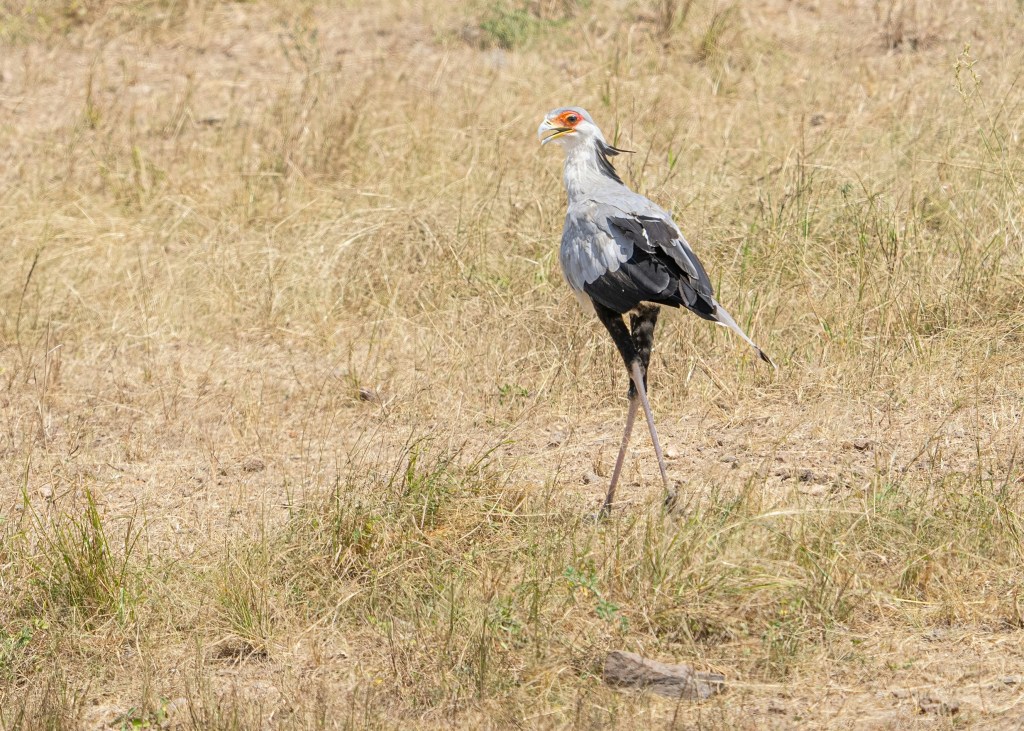
Start here because nothing else makes the case quite as powerfully.The secretary bird stands over a metre tall on legs that belong on a crane, not a raptor. It does not hunt from the air. It walks. Every day it covers open grassland on foot, head down, moving with deliberate purpose through the Maasai Mara, Amboseli, Samburu, and Tsavo.
When it finds a snake, it does not use its beak. It stomps. Researchers studying secretary bird strike mechanics recorded blows delivered at five times the bird’s own body weight in under 15 milliseconds fast enough and forceful enough to stun or kill a venomous snake before the snake can respond. The bird then repeats the strike until the prey stops moving.
This is a raptor that kills by foot. On the grassland. In full view of any game drive vehicle that bothers to stop.Most do not stop.
The secretary bird is not on the bucket list. It does not have five in its name. Guests see a large bird walking and move on.
Do not be that guest.
Where to spot it in Kenya: Open grassland across the Maasai Mara, Amboseli plains, Samburu’s open areas, and Tsavo East. Most active in the early morning when it begins its daily patrol.
The Kori Bustard: The Heaviest Flying Bird in Kenya
The kori bustard holds a record most people do not know exists. It is one of the heaviest birds capable of flight on the planet, with males weighing up to 19 kilograms. Despite this, it spends almost all of its time walking slowly through open savannah, feeding on insects, lizards, and the occasional small snake.
The kori bustard is not a subtle bird. It is large, upright, and moves through the grass with a slow deliberate gait that makes it easy to track once you know what you are looking for. During the breeding season males perform elaborate display walks, puffing up their throat feathers and fanning their tail to an extraordinary size.
Yet it consistently gets overlooked on game drives because it does not move quickly, does not make dramatic sounds, and does not appear in predator highlight reels.
Where to spot it in Kenya: Maasai Mara, Amboseli, and Tsavo. Often seen in pairs or alone on open plains away from dense bush.
The Somali Ostrich: Samburu’s Distinctive Giant
Most visitors to Kenya will have seen the common ostrich. Fewer will know that Samburu National Reserve is home to a distinct species: the Somali ostrich, identifiable by its blue-grey neck rather than the pink-red neck of its southern cousin.
The Somali ostrich is one of the Samburu Special Five. Five species endemic to Kenya’s northern frontier that you will not reliably find anywhere else in the country. It is larger than the common ostrich, equally fast on the ground at speeds of up to 70 kilometres per hour, and equally dismissive of the idea that birds should fly.
On a game drive in Samburu, the Somali ostrich is impossible to miss if you are looking at the right level. At ground level.
Where to spot it in Kenya: Samburu National Reserve and the wider northern frontier. Less common in southern Kenya parks.
Helmeted Guineafowl
No ground bird in Kenya is more commonly seen and more consistently underestimated. Helmeted Guineafowl travel in large, noisy flocks across virtually every ecosystem in the country. They are loud, chaotic, and relentlessly entertaining.
What most visitors do not know is that guineafowl are ecologically important. They consume enormous quantities of ticks and insects, making them natural pest controllers across Kenya’s farmlands and game reserves alike. They are also a key prey species for servals, jackals, and large raptors.
If you see a flock of guineafowl scatter suddenly and go silent, pay attention. Something is hunting nearby.
The Crowned Lapwing: The Bird That Will Tell You Everything
This one is not about drama or record breaking size. The crowned lapwing is a practical tool for any safari guest who wants to read the bush more accurately.
A medium sized ground bird with a distinctive black and white crown and a red bill, the crowned lapwing is intensely territorial and almost permanently alarmed. When a predator moves through its territory, the lapwing screams. It does not stop screaming until the threat passes.
Experienced guides listen for lapwing alarm calls the way birders listen for a dawn chorus. If a group of crowned lapwings suddenly becomes very loud and very agitated at the edge of a clearing, something is moving through the grass that does not want to be seen.
Learn to recognise the call. It will find you wildlife that a visual scan alone never would.
Where to spot it in Kenya: Ubiquitous across open and semi-open habitats throughout Kenya. Roadsides, airstrip edges, and short grass plains.
Why ground birds matter on a safari
Experienced guides read ground birds the same way they read tracks or broken grass. Guineafowl flushing suddenly, a Secretary Bird changing direction, a lapwing alarm call that does not stop. All of these are signals.
Ground birds are also often the first thing guests can observe closely and clearly on a game drive, before the leopard is found or the lion lifts its head. Learning to read them properly changes the entire experience of being out in the bush. They reward patience and attention in a way that big game sightings sometimes do not.
Practical Tips for Spotting Kenya’s Ground Birds on a Game Drive
Shift your eyeline. The instinct on a game drive is to scan at horizon height. Ground birds live below that line. Consciously dropping your gaze to the grass level at regular intervals will double your sightings within a single drive.
Ask your guide to stop for ground birds. Many guides will not stop unless they think a guest is interested. Most guests have not communicated any interest because ground birds are not on the standard request list. Telling your guide at the start of a drive that you want to see secretary birds and bustards changes the entire experience.
Use midday productively. The hours between 11am and 3pm are traditionally quiet for mammal activity but ground birds remain active throughout. A midday drive focused on ground species is one of the most productive and underused safari strategies available.
Do not dismiss what does not move dramatically. Ground birds are not ambush predators or sprinting prey. They move slowly, deliberately, and quietly. The temptation to keep driving is real. Resist it
Watch the grassland edges. Ground birds use the transition zone between open grass and bush for hunting, nesting, and shelter. These edges are almost always more productive than the open plain or the dense bush alone.
The Wider Point
Kenya has over 1,100 bird species. The five mammals on every guest’s checklist are extraordinary. But they represent a fraction of what is actually happening in the ecosystem around every game drive vehicle.
Ground birds are the entry point for a different way of experiencing Kenya’s wildlife. Not as a checklist. Not as a highlight reel. But as an ecosystem where everything is connected and almost everything is worth stopping for.
The secretary bird is waiting in the grass right now. Most game drive vehicles are going to pass it.
Do not be one of them.
Follow Apex African Safaris on Instagram, Facebook, X, and Threads for daily Kenya wildlife content. Tag us in your Kenya bird sightings using #LetTheWildBeYourGuide